Most Gen Zers want to live in cities, but that may require giving up homeownership


If you asked a room full of 20-somethings where they’d love to plant roots, a lot of them would point straight to a city. The version of young adulthood many Gen Zers are picturing right now includes walkable streets, coffee shops around the corner, friends a short train ride away, and a commute measured in minutes instead of hours.
The catch is that in today’s housing market, buying a home in the neighborhoods they want isn’t always realistic.
That tension shows up in Apartments.com data from its City Comeback Index survey and Rent Forever survey, both conducted in 2025. Over the past two years, Apartments.com research has found that Gen Z renters are willing to stay flexible with their living situation to maintain the lifestyle they want and keep their commute short.
For a growing number of young adults, that flexibility means choosing to rent in a city they love rather than buy a house somewhere they don’t — at least for the foreseeable future. And increasingly, Gen Z is redefining renting as less of a temporary stop on the way to homeownership and more of a long-term housing choice.
Key Takeaways
- Eighty percent of Gen Zers (ages 18-29) who expect to buy a home in the next three years would live in a walkable, transit-connected city neighborhood if it would cost the same or less than a suburban home.
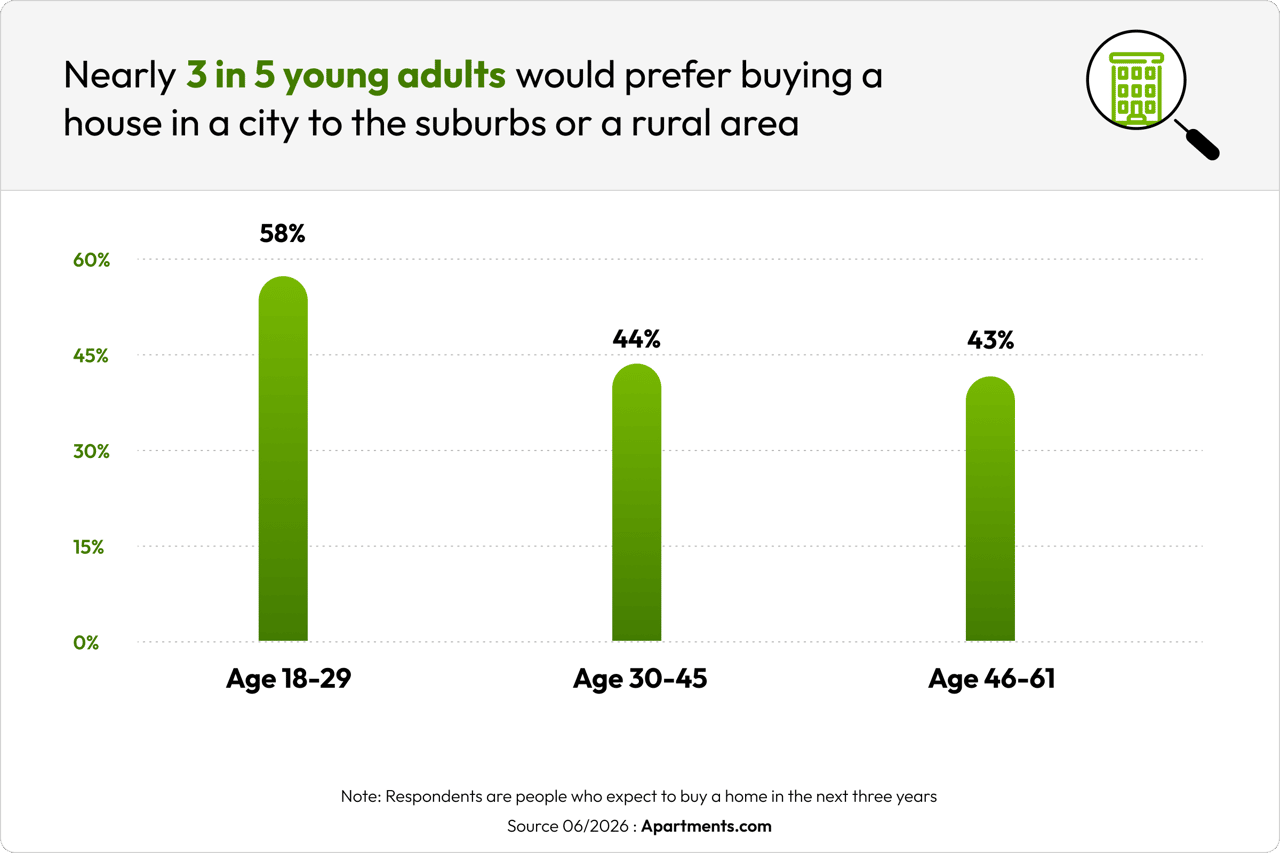
- Fifty-eight percent of Gen Z prospective homeowners say their preferred neighborhood is in or on the edge of a city, more than any other generation. Just 44% of millennials (ages 30-45) and 43% of Gen Xers (ages 45-61) say the same.
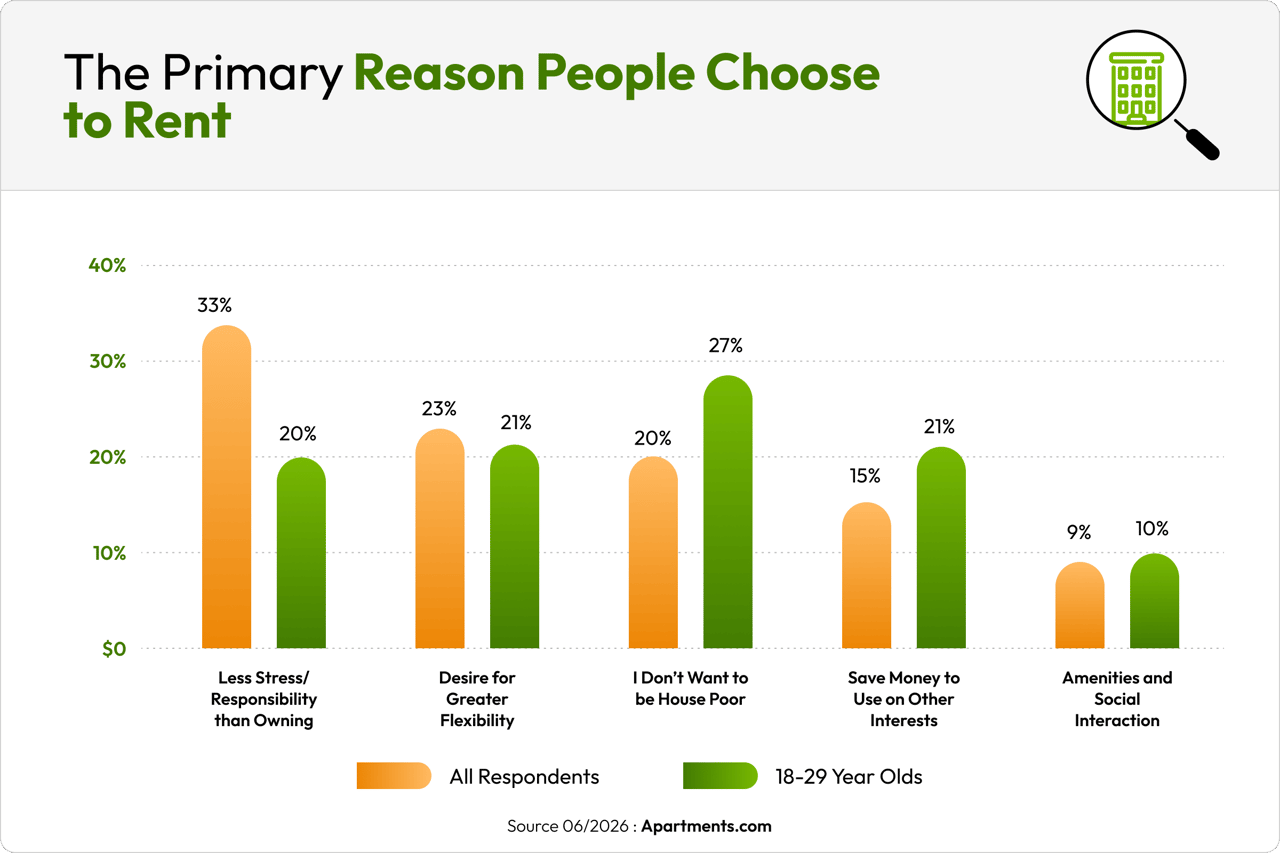
- In 2025, 27% of people ages 18-29 said they chose to rent because they don’t want to be house-poor, a higher share than the general population (20%).
- Forty-two percent of Gen Z prospective homeowners say their interest in city living has grown over the last two years, far more than any other generation.
- Twenty-eight percent of Gen Z prospective homeowners buying a home is about equally affordable in urban and suburban areas, compared to 23% of millennials and 23% of Gen Xers.
Both Gen Z Renters and Homeowners Dream of City Living
City living has real pull for Gen Z renters, more so than for any older generation. Among young adults who expect to buy a home in the next three years, 58% say their ideal neighborhood is a city — either downtown (22%) or a bit farther out toward the city’s edge (36%). Compare that to older prospective buyers, where 44% of millennials and 43% of Gen Xers say the same, and a clear generational preference starts to take shape.
The reasons behind that preference are pretty relatable. Gen Zers generally want to be close to their friends and the amenities that make daily life easier and more fun. Compared to millennials and Gen Xers who plan to buy soon, young adults are more likely to prioritize walkability, proximity to shopping, entertainment, loved ones, and green space, and a shorter commute. Gen Z adults tend to be willing to spend on experiences, and cities put a lot of experiences within reach.
Among prospective Gen Z homeowners, these are the features they’re most likely to call important. In each case, they lead every other generation:
- Parks, outdoor recreation, and green space: 60%
- Proximity to a job or a short commute, plus work flexibility: 54%
- Walkability and closeness to shops, restaurants, and family and friends: 53%
- Culture, dining, and entertainment: 43%
Gen Z Renters Are Also Future-Thinking
It’s tempting to assume Gen Zers gravitate toward cities simply because they live in the “now.” But the numbers contest that theory: Prospective Gen Z and millennial homeowners are equally likely (54%) to say that quality schools and a family-friendly community matter to them, a higher share than older generations. In other words, wanting a city doesn’t mean not wanting the things people traditionally associate with the suburbs. Many young adults simply want both.
None of this means every Gen Zer plans to stay in the city forever. But right now, urban living is a genuine priority for many young prospective homeowners.
In Major Cities, Renting Is Often the Best Option for Cash-Strapped Young Adults
The dream often meets the price tag for Gen Zers. Currently, 57% of Gen Zers who expect to buy a home soon already live in a city. However, 80% say they would live in a walkable, transit-connected city neighborhood if it cost the same as or less than a suburban home. That gap between where they are and where they’d like to be is wider for Gen Z than for older buyers: 68% of people ages 30-45 and 65% of those ages 46-61 said the same.
The Reality Check
The math of suburban versus city living isn’t always what most would expect. Suburban homes are sometimes less expensive than city homes. So in exactly the places young adults most want to live, buying downtown often costs a serious premium.
New York City is the clearest example. There, suburban homes are about 43% less expensive than homes in the urban core. The average NYC home costs nearly $3 million, while renters can expect to pay around $4,185 per month for an apartment. That rent figure is still well above the national average, but it makes renting far more attainable for a young adult than saving up to buy in the same neighborhood.
It also helps explain why 28% of Gen Z prospective homeowners say buying feels equally affordable in urban and suburban areas. This is a higher share than millennials (23%) or Gen Xers (23%), which may nudge even more of them toward staying put in the city.
Add it all up, and plenty of young adults who want the bustle of a major metro may end up renting for the foreseeable future — often by choice.
In 2025, 20% of U.S. adults said they rent because they don’t want to be house-poor, and that number climbs to 27% among people ages 18-29. Beyond avoiding a stretched budget, Gen Zers also commonly say they rent because they want:
- Greater flexibility (21%)
- Less stress and responsibility than owning (20%)
- Access to amenities and social interaction (10%)
Different Milestones for Different Generations
For a long time, buying a home has been treated as one of the major milestones of adulthood. But not everyone wants to own right now, and for many Gen Zers, renting in the city is a trade-off they’re glad to make if it means living the life they actually want.
Young adults are navigating a tough job market and, like everyone else, absorbing the high cost of living. Cities can carry a higher overall price tag than the suburbs or the countryside, but they also tend to offer better access to jobs and a steady supply of free or low-cost events and services. Work is a serious factor here, too: 39% of Gen Z prospective homeowners say that even with some hybrid or remote flexibility, their work situation heavily shapes where they’d buy.
All that said, it’s fair to acknowledge the other side of the coin. For some young adults, setting aside the goal of homeownership stings, even when the decision makes sense on paper. It can be genuinely hard to let go of a milestone you grew up expecting to hit on a certain timeline.
Those struggling with the idea of homeownership are far from alone. Many people are choosing to rent long-term, and it’s one more example of the tricky financial spot a lot of Gen Zers find themselves in. In fact, more than 1 in 3 (35%) Gen Zers say they’d accept delaying major life goals as a housing affordability trade-off, compared to 21% of all adults.
The Suburbs Aren’t Calling Yet. Young Adults Are Becoming More Interested in City Living Over Time
If you’re expecting this to be a phase Gen Z grows out of, the data says otherwise, at least for now. A full 42% of Gen Z prospective homeowners say their interest in city living has grown over the last two years, dramatically more than older generations, where just 27% of 30- to 45-year-olds and 23% of 46- to 61-year-olds say the same.
Rather than cooling on cities as they get a little older and a little more established, young adults are leaning in. It makes sense given the moment they’re in: cities offer proximity to jobs, opportunities to build a network, and a lower-commitment way to live somewhere expensive while they get their financial footing. For a generation focused on both today’s lifestyle and tomorrow’s stability, urban living checks a lot of boxes.
Methodology
The City Comeback Index survey was conducted by Centiment on behalf of Apartments.com. The survey was fielded in late 2025 and is based on 1,045 completed responses from U.S. adults who indicated they were looking to buy a home within the next one to three years. The Centiment data is unweighted.
The Rent Forever survey of 523 adults ages 18 and over was conducted via SurveyMonkey Audience for Apartments.com on April 10, 2025. Data is unweighted, and the margin of error is approximately +/-4% for the overall sample with a 95% confidence level.
This story was produced by Apartments.com and reviewed and distributed by Stacker.
